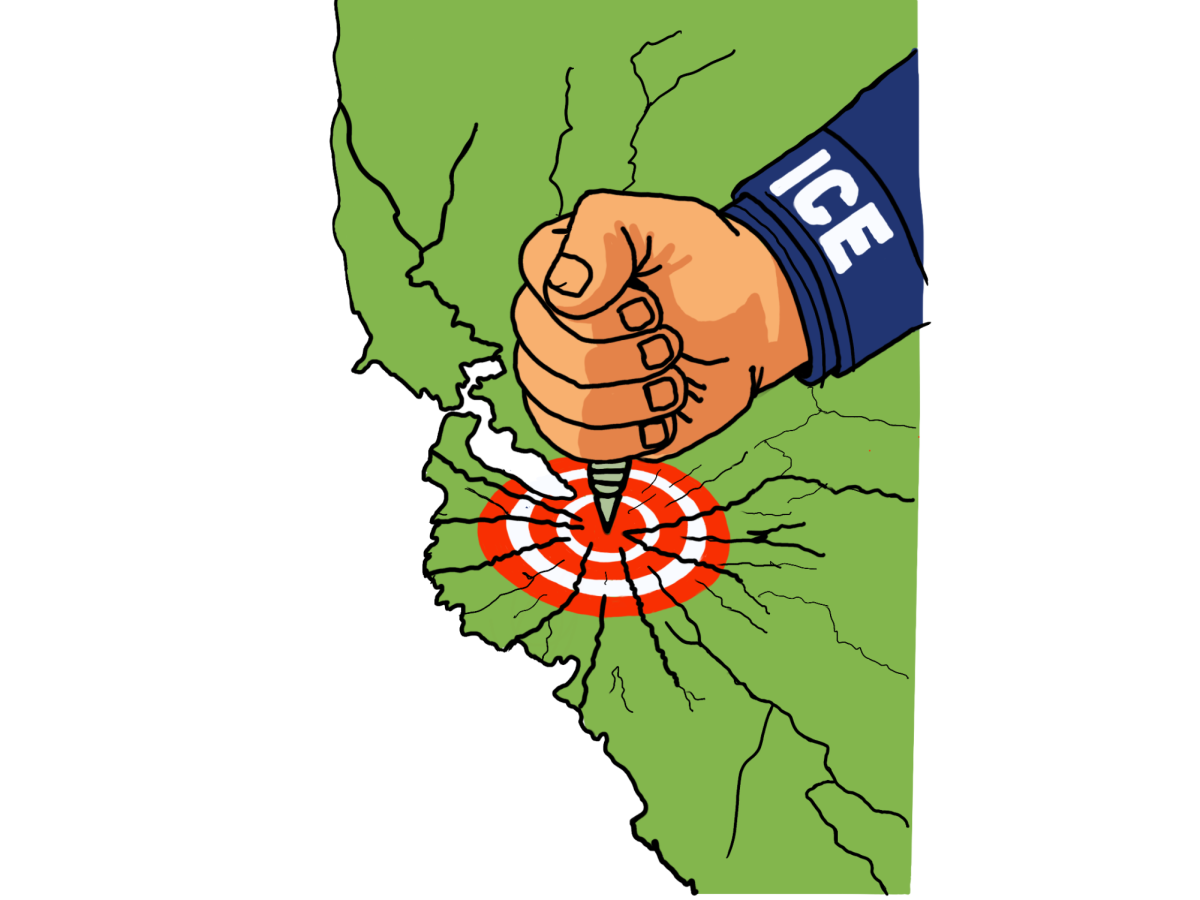
In Nick’s house, a knock on the door means something different. His family freezes. Eyes dart toward the entrance. Nobody speaks until someone carefully peers through the window to see who is standing outside. Is it a neighbor? A stranger? A man in a vest with a badge? This is the reality for Nick, a Bay Area High School Student, every day, an immigrant who asked that his real name not be used out of fear of ICE. He has grown up in a country that does not always feel like it belongs to him, in a home where the sound of footsteps on the front porch can send a chill through the room. For his family, ICE is not a distant political issue debated in Washington or in the comment sections of news articles. It is a quiet but persistent fear for him and his family that they could be separated at any moment. It is the reason they hold their breath when someone knocks.
“It’s always in my head every time we get a knock on the door, or someone talks about immigration raids on the news,” Nick said.
Nick said the fear is not tied to a single event but to a pattern of stories he picks up from relatives and loved ones.
“I hear stories from cousins and friends whose uncles or aunts got pulled away by ICE agents at work or on the street,” Nick said. “It’s like an everyday worry that someone could just show up at our door and tear our family apart.” According to a Pew Research Center article, 59% of Latinos say they have seen or heard of ICE arrests or raids in their local area in recent months, showing the immense impact ICE has had throughout the U.S.
Nick expressed moral outrage towards the killing of people in the United States by ICE agents, the most prominent of which occurred in Minneapolis. “When I see news about ICE agents shooting people, like the killing of a woman in Minneapolis … I feel sick and angry,” Nick said. “It seems like instead of protecting people, these operations are hurting families and communities.” Currently, a quarter of U.S. adults live in fear that they or someone close to them could be deported by Immigration and Customs Enforcement at any moment, according to the Pew Research Center. Conversations about immigration have become a regular part of family life for Nick, as he and his parents often discuss current events at the dinner table, especially when enforcement activity increases in certain cities.
“They tell me they’re proud of who we are but also remind me to be careful and aware of our rights because they’ve lived through fear and know how real it can feel,” Nick said. The uncertainty has also shaped his daily choices. Nick said his family avoids international travel out of concern about reentry, even if it means missing important events. “I can’t just jump on a plane because we’re afraid of not being able to come back,” Nick said. “That means missing tournaments and important family moments. Part of my brain is always thinking about whether I’ll be able to chase my dreams without fear hanging over me.”
Not only are Bay Area students feeling unsafe when traveling, according to a study by Stanford education professor Thomas Dee, reported by The Journalist’s Resources, the 2025 immigration crackdown is also affecting students across the country by lowering their attendance and grades.
“I don’t even want to go to school anymore, and for that, I’ve been doing worse in school because that’s all I think about,” Nick said. “I worry that if I’m not home, I’ll be more exposed to problems with ICE, or people in my family might be in danger while I’m not home.”
Olivia, a student at Palo Alto High School who also asked that her real name not be used out of fear of ICE, a child of undocumented migrants, ousted the Trump administration for its handling of the deportation of documented immigrants in her view. “They say they’re going to deport criminals, but they take away innocent people who work hard and sometimes even have documentation,” Olivia said. “There’s also a feeling of helplessness because I’m very proud of my culture.”
Additionally, Olivia doubts the Trump Administration for keeping the Deferred Action for Childhood Arrivals program in place for children who arrived in the United States. This matters to her because members of her family use the program. The program is meant to provide a clear temporary residence status that protects the individual from deportation and grants legal work authorization.
“It doesn’t seem like ICE cares whether or not you have documentation, so my siblings are also afraid because they have DACA, but since the president hates us, there is a possibility for him to take that program away,” Olivia said. According to the U.S. Citizenship and Immigration Services website, new DACA requests are not currently being processed by the government. However, requests for renewing DACA status continue to be filed and processed.
Olivia says that the ICE raids have been affecting her academic performance due to the constant stress.
“I feel distracted when all I’m thinking about is whether or not we are safe, and it affects the quality of my school work,” Olivia said.
The fear of deportation by ICE has also become a constant, daily struggle for Olivia. Even outside of school, she fears for her family, who are constantly paranoid of being spotted by government agents.
“It has impacted our lives because we have to be more careful of where we go and check the local news and online resources to see if ICE has been spotted in the area,” Olivia said. “It’s also just a constant anxiety that we have to live with.”
According to Newsweek, Minnesota Governor Tim Walz gave a graduation speech at the University of Minnesota Law School in May last year, in which he compared ICE to the Nazi’s secret police under Adolf Hitler.
“Donald Trump’s modern-day Gestapo is scooping folks up off the streets,” Walz said. “They’re in unmarked vans wearing masks. Being shipped off to a foreign torture dungeon.”
Paly U.S. History and Foreign Policy teacher Adam Yonkers shares that despite America being a country of immigrants, there has been a long history of discrimination against minority groups.
“You saw discrimination against the Irish,” Yonkers said. “You saw discrimination against Jews by turning them away at various points in American history. So even though we are a nation of immigrants, there have been a lot of instances of being anti-immigrants.”
At the same time, Yonkers warns that the comparison of the Gestapo with ICE, however much justified, might not be the most historically accurate connection to make.
“I think the way a lot of these ICE officers are operating is that they’re operating with impunity, without any sort of IDs,” Yonkers said. “The Gestapo is a convenient historical similarity. … I don’t think [the comparison] is historically consistent, like some methods being used [by ICE] are problematic, but I don’t think it is necessary.”
In support of Walz’s statements, Olivia does not think the comparison between the Gestapo and ICE is too far of a stretch for her.
“I mean, they are both kidnapping people and taking them away,” Olivia said. “It’s just not concentration camps, at least not yet.”