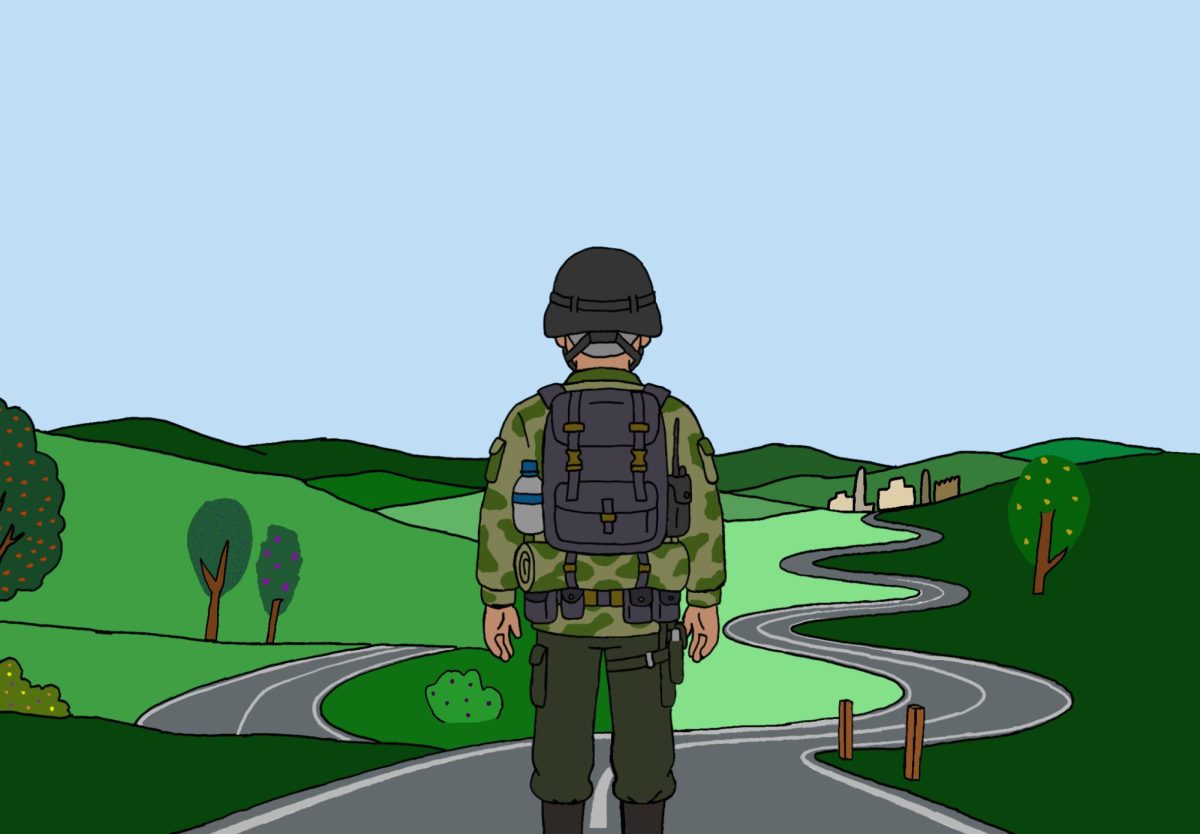
Would you be willing to put your name in the draft pool and fight for your nation?
If you’re a male aged 18 to 26, you no longer have a choice. At least as far as registering for the draft system, even though there is no current draft. That’s because the National Defense Authorization Act signed by President Donald Trump and passed in December, gives the federal government as of this coming December the power to automatically register qualifying men ages 18 to 26 who have a Social Security number.
With the large number of people this bill will be affecting, we’ve seen very minimal conversations being had about it. Few Palo Alto High School students we spoke with had even heard about the bill.
How is it possible that such a significant change to our system has not been a popular topic of conversation among high school students, especially because many of them are going to be entering the age range of 18 to 26 years old very soon?
With such little awareness of the bill, there is no telling how people will react if a war actually starts, given many people would be forced to serve.
In the past, the only way to enter the draft pool was by registering yourself in the selective service. For instance, during the Vietnam war, there was an active draft and therefore, young men were legally required to enter. Currently, there is no active draft, yet still young men will be automatically placed into the draft pool, according to CNN.
Is this automatic military registration an unfair use of the government’s power? A clear breach of personal autonomy?
To be clear, registering for the Selective Service – the pre-draft list of eligible young men – has not been optional. It has been required for decades. Now, the process is automated.
Currently — and since 1973 — actually serving in the military is voluntary; U.S. military service is an all-volunteer operation.
Although registering is mandatory, actually serving in the military is voluntary. The U.S. has maintained an all-volunteer armed forces since 1973, and a draft would only be activated if specifically authorized by Congress and the president.
Palo Alto High School history teacher Stephen Foug, explains the difference in the process since he was 18.
“I remember going down to the post office, and you fill in a little form,” Foug said. “I voluntarily did it as a sense of patriotism. That’s the old system.”
Military service is also a topic of discussion in many other parts of the world outside of the United States.
Sophomore Mahé Romain Loeuillet, who is currently attending Paly as a part of an exchange year program from France, shared his plans for enrolling in the French military following high school.
“I’m joining the military academy in high school,” Loeuillet said. “I have two years of studying in the military … and after that, I get drafted.”
Serving in the military can cause lasting effects that are harmful not only to the person themself, but also to their family and friends. According to DAV, 10 percent of veterans from the Vietnam War reported experiencing PTSD at some point. Making these life changing decisions requires careful consideration.
Furthermore, the new auto-enrollment of 18-year-olds relies on technology that could be better put to other uses, according to some.
“Those are efforts going in the wrong direction, I’d be more in favor of mandatory voting,” Foug said.
Could this seemingly innocuous shift from personal enrollment at the post office to automatic enrollment be a problem for Americans?
“If you look at US history, the Civil War, there were draft riots,” Foug said. “God forbid that actually happens. … [but] this country has to? brace for that.”
When we first came across the new bill on Instagram, we couldn’t believe it was true. Being in high school, we are nearing the age that would be directly affected by this bill. Also, with multiple wars going on across the world and with political tensions high, we worry a larger war may ensue in which we would be forced to participate. Wouldn’t you worry about it too?
Right now, there is no draft in action. In passing this bill, however, the government is more ready than ever to activate a draft at a moment’s notice. Could the bill simply have given us a more efficient way of doing something we’ve been doing inefficiently — or could something bigger be coming?