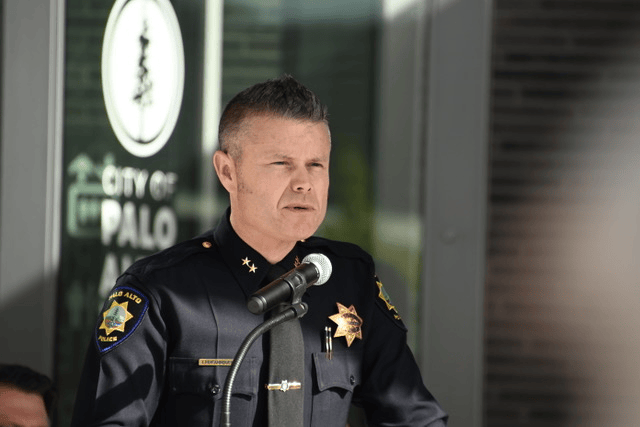
Acting Chief Reifschnieder speaks last month to the Palo Alto Police Foundation, as he assumed the role of Chief. His main philosophy as chief is to be respectful to both officers and civilians alike. “I tell folks, you gotta treat everything like a relationship,” Reifschnieder said. “Even if they’re the “bad guy” today, it doesn’t mean that I have to treat them unprofessionally or disrespectfully.”
“I feel intimidated by the police a lot,” Palo Alto High School senior Isabella Nunez said. “I have seen videos of the police manhandling people, and the way they shout commands at you, it would scare me. I mean they’re supposed to be protecting people and keeping them safe. … I guess I also feel more intimidated as a woman. If they manhandle me or search me I’d feel really scared.”
Nunez is one of many community members with an apprehensive view of law enforcement. The publicized murder of 46-year-old George Floyd in 2020 and the killing of Renée Nicole Good by an immigration control officer in January 2026 lead many people to ask questions about their local law enforcement.
According to a 2023 Public Policy Institute of California survey, 50% of Californians perceive their local police protection as “good” or “excellent,” down from 78% in 2011.
Although Palo Alto is ranked the 11th safest American suburb, according to financial advisor SmartAsset, Nunez says she still feels influenced by social media and news to fear law enforcement.
Acting Palo Alto police chief James Reifschnieder is trying to combat these skeptical views of police.
“We don’t want the Paly or the Gunn (High School) student who is walking to school, minding their own business, to see a police officer go by and be fearful,” Reifschnieder told Anthro during an interview (when? In January?)at the police department. “I want people who are following the rules to feel safer when they see a police officer around.”
Junior Navya Narayanan says she feels that having more community presence from police would help them seem more approachable towards students.
“I think they [police] could be more engaged with the community,” Narayanan said. “Letting more people know what’s happening is important, and could be improved. I think the police could be more engaging with students and have a less intimidating appearance.”
In fact, police used to have a presence at every PAUSD high school, but stopped due to the pandemic. Through the School Resource Officers program, officers did not only monitor safe driving, but built relationships with staff and students.
“The most important part of that program was the regular presence of the same two cops on campus regularly in a non-enforcement setting,” Reifschnieder said. “It gave us a great opportunity to have those officers be able to build a rapport with the students and have the students feel like they could interact with them [officers] more informally, to get to know them as a person and not just some guy or some gal with a badge.”
In addition to the familiarizing SRO program, the police’s Psychiatric Emergency Response team receives specialized training paired up with a clinician to respond to mental health calls from teens in crisis. Reifschnieder says this program is especially necessary in PAUSD, a district which has experienced three teen suicide clusters in under 20 years.
“It gives us that extra tool on the belt when we have a trained mental health professional who can take the lead,” Reifschnieder said. “PER came to Palo Alto in 2021, and we were one of the first two agencies in the country to establish it. … From an officer perspective, responding to suicide calls is emotional and impactful and something that I would wish away for all my officers if I could.”
Many student impressions of police officers, like sophomore Zev Gur’s, stem from ongoing conflicts with federal immigration control officers.
“I think here, the police have mostly good intentions,” Gur said. “But I’ve seen a lot of news articles about ICE officers shooting women in other areas.”
Many people confuse federal with local agents, however they have different duties, limitations and rights, according to Reifschnieder. This difference means police are not allowed to be in “cahoots” with federal agents like ICE officers, according to Reifschnieder..
“There’s a law called the California Values Act that was enacted several years ago that puts a bunch of limitations on local law enforcement’s ability to cooperate with federal officials for purposes of immigration enforcement,” Reifschneider said. “The only way we would get involved [with federal enforcement] is if there were a safety issue. … If you have a question, then call us, and we’ll get to the bottom of it. Our most basic job is to keep the peace, so I’d rather have us try to get involved and mediate some sort of a safe resolution than have people wonder.”
While he recognizes some fear around law enforcement, Reifschnieder acknowledges how necessary policing is when done right.
“I recognize that there’s skepticism and additional attention being paid to law enforcement, some of which is well-deserved,” Reifschnieder said. “Just remember that we need good law enforcement, and we need good people to do it. If there’s one thing cops like, it’s kids, so don’t be afraid to come talk to us. I suspect that if you did, you would walk away feeling better about the police officers that serve your community.”