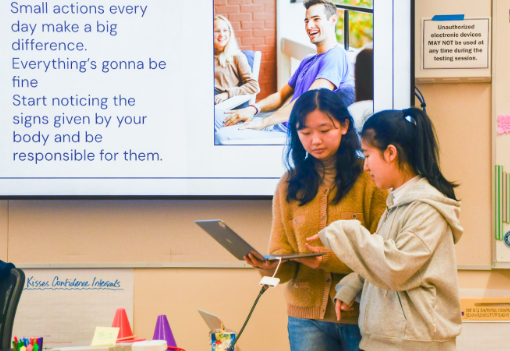
Two students stride through the front of the room. Whispers among the audience members fade as the screen brightens at the click of a computer key, plunging the audience into the intricacies of the human mind.
Fighting against the high-stakes pressures of student life, the Palo Alto High School Clinical Psychology Club has emerged as one of the many campus resources aimed at supporting students’ mental health and well-being. The club meets biweekly on Wednesdays during lunch in room 858.
Sophomore Isabella Zheng, co-president of the club, said she created it to provide students with ways and spaces to better manage the stress around them.
“The main reason we started this club is [because] we really want to improve the mental health condition of students at Paly,” Zheng said. “Since this is a really stressful district, we really hope students can develop some ways to relieve stress, like when they’re coping with schoolwork and stuff.”
Selena Luo, co-president of the club, and Zheng take a practical approach in using psychology to help students manage various stressors in their lives.
“We help them through the perspective of psychology,” Luo said. “For example, during the class, we teach them how to cope with procrastination, which is pretty common among the students in high school. We also teach them how to cope with depression, anxiety, or all the stuff that usually can be seen around the campus.”
To Zheng, this club is personal, allowing her to pass on the scientifically researched knowledge and coping strategies that have worked for her to her peers.
“As a student at Paly, I’ve experienced a lot of stress myself, and the way I cope [with] that is to research some psychology studies that help me to increase … my overall mental health, and that’s really helpful to me,” Zheng said. “I hope to share those experiences with other students as well.”
In doing this, Luo and Zheng use campus resources and partner with other clubs to organize activities throughout the year.
“Last year we hosted a PRIME with the Wellness Center and with [the] Origami Club,” Luo said. “ So we have [attendees] have fun with the Origami Club to release some stress. … We really hope to cooperate with the Wellness Center, and we are also planning in the future to do some slime making, and all those kinds of events for the students to basically have some fun.
Despite all this success Luo and Zheng have had with their club, they have also endured their fair share of obstacles.
“Sometimes during the club, it’s pretty hard to engage with students,” Luo said. “And it’s also, like, really hard to spread all the information. … It’s pretty hard to manage the connection with the Wellness Center, and also [ask] if any clubs would like to collaborate with us.”
Luo shared that to get students the help they need without feeling pressured, they offer multiple solution that don’t requires students to share their problems with the class.
“When we talk about those mental disorders, we have some options that you can do,” Luo said. “Since we already give those options … and even if they [want to participate in the discussion], they know some of the analogy of it, and they can try to, first of all, deal with themselves, or second, or go to the Wellness Center, or talk to us.”
Despite all the initial struggles in finding partnerships with campus resources and engagement rate, Luo emphasizes the importance of their effort within this club.
“We feel like the more you know about these disorders [mental disorders], the less you’re afraid to talk about them and to share your ideas with others,” Zheng said.