Palo Alto High School’s Social Justice Pathway has over a decade-long history of social activism on campus.
With projects ranging from CSPAN StudentCam to Junk couture — a yearly fashion show made from newspapers, chickenwire and draped fabric — it is a bastion of creativity on campus.
The pathway’s mural “Same moon, same stars,” which celebrates the Cherokee nation is passed by hundreds every day. Now, the pathway will be welcoming two new teachers next year.
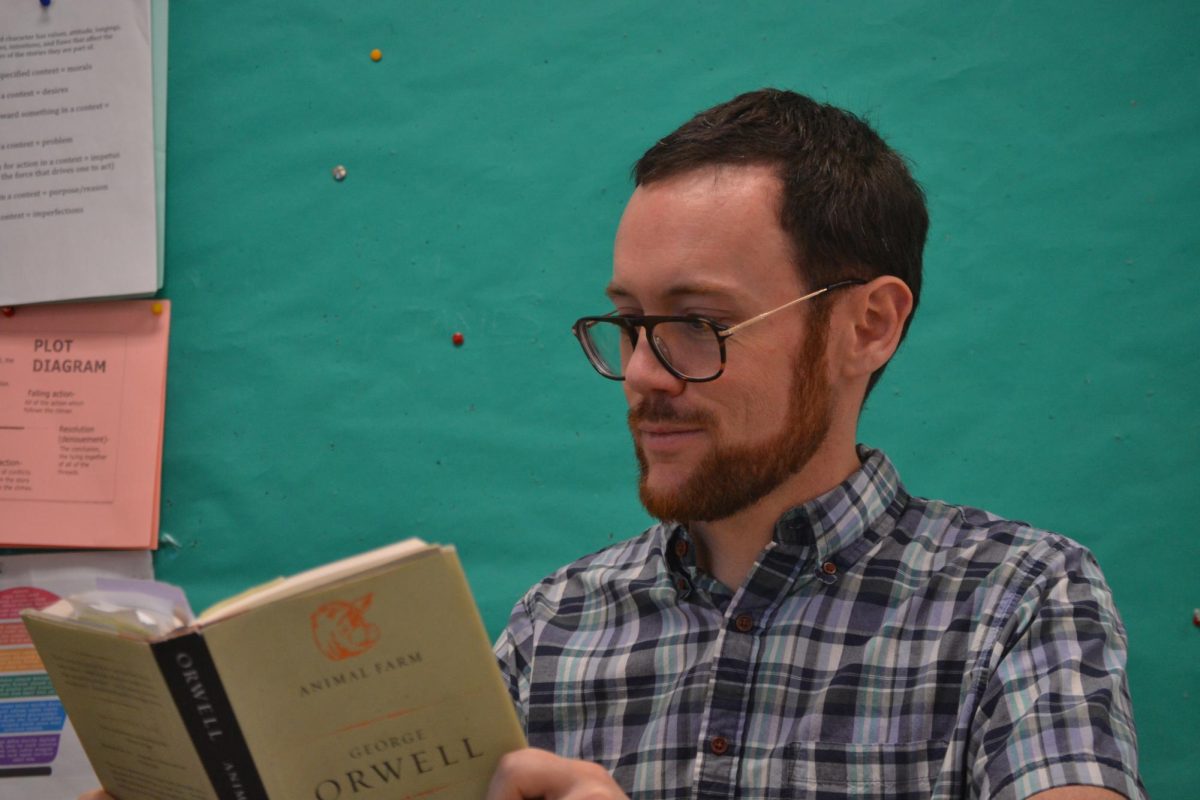
Joshua Knowles-Hinrichs, an English 10A and Comedy Literature teacher at Paly, and Sebastian Castaneda, an Ethnic Studies and history teacher, will join the program as the teachers for the Class of 2029 cohort, replacing Erin Angell and Austin Davis.
Knowles-Hinrichs said he joined the program because he believes that civic engagement is an essential part of democracy.
“We definitely need, in the modern day, more people to be actively engaged in politics and governance,” Knowles-Hinrichs said. “I want to try and make them [students] or help them see … that engagement is worth it.”
According to Knowles-Hinrichs, the current SJP teachers helped new teachers by recruiting new students to the program, giving Knowles-Hinrichs and Castaneda time to plan their curriculum.
“The people who have more experience help … talk to the different classes and get students informed about the opportunity to join SJP, and then also to communicate with their families about any questions,” Knowles-Hinrichs said.
According to Knowles-Hinrichs, before he and Castaneda were selected, they had never met.
“Once we found out that we were both going to be doing SJP next year, the administration set us up with some days where we were able to get substitutes and then just spend the full day together,” Knowles-Hinrichs said. “First getting to know each other, [then] finding out our common interests and our common goals for the program.”
Knowles-Hinrichs said that the close personal relationships teachers build with their students over three years excites him.
“You’re always going to see the students be more successful academically if you also build a relationship with them as individual human beings beyond just their goals in terms of grade and your curriculum specifically,” Knowles-Hinrichs said. “The social justice pathway has a lot of that built into the fabric of what it is.”
Knowles-Hinrichs has had a history of being involved with social activism, saying that when he was a high schooler at Henry M. Gunn High School he participated in the Youth in Government program through the YMCA. He currently hosts the Youth Community Service Club in his classroom.
“[It’s] definitely important to me, being involved in the local community and broader political discussions, national ideas about what we want the trajectory of the United States to be and things like that,” Knowles-Hinrichs said.
Knowles-Hinrichs plans to have lessons that build off of Castaneda’s lessons.
“We will have activities that build off of each other or feed into each other from period to period since the SJP periods are back to back,” Knowles-Hinrichs said. “That means more continuity.”
In these lessons, Knowles-Hinrichs expects communication from his students.
“I value communication going both ways,” Knowles-Hinrichs said. “I want to know if students have some kind of challenge, whether that’s with academic contact, with a scheduled thing, whatever they’re comfortable sharing in terms of side influences on their ability to focus.”
Hinrich currently teaches five classes, and will do the same next year.
After one year as a substitute teacher, Castaneda began working in the Palo Alto Unified School District full-time this year. He currently splits his time between Gunn and Paly.
Castaneda said he hopes to educate students about politics and the injustices of our world — something he was oblivious to in high school.
“SJP serves as a good avenue to try and address those injustices,” Castaneda said. “It could help inspire students as the general goal to help make the world a better place, which I think is my goal as a teacher overall.
Castaneda said he is excited to collaborate with another teacher, a keystone of the SJP program.
“As a new teacher, I’m always … looking for new ways to expand my teaching repertoire,” Castaneda said. “Being able to collaborate is always a plus for me.”
Knowles-Hinrichs said he hopes his students take what they learned from his class and apply their skills in the professional world.
“I hope, and I expect that they’ll all be able to see ways that the experience of social justice directly informs their decision making … going forward professionally, socially, in terms of activism, and their engagement with civic society,” said Knowles-Hinrichs.