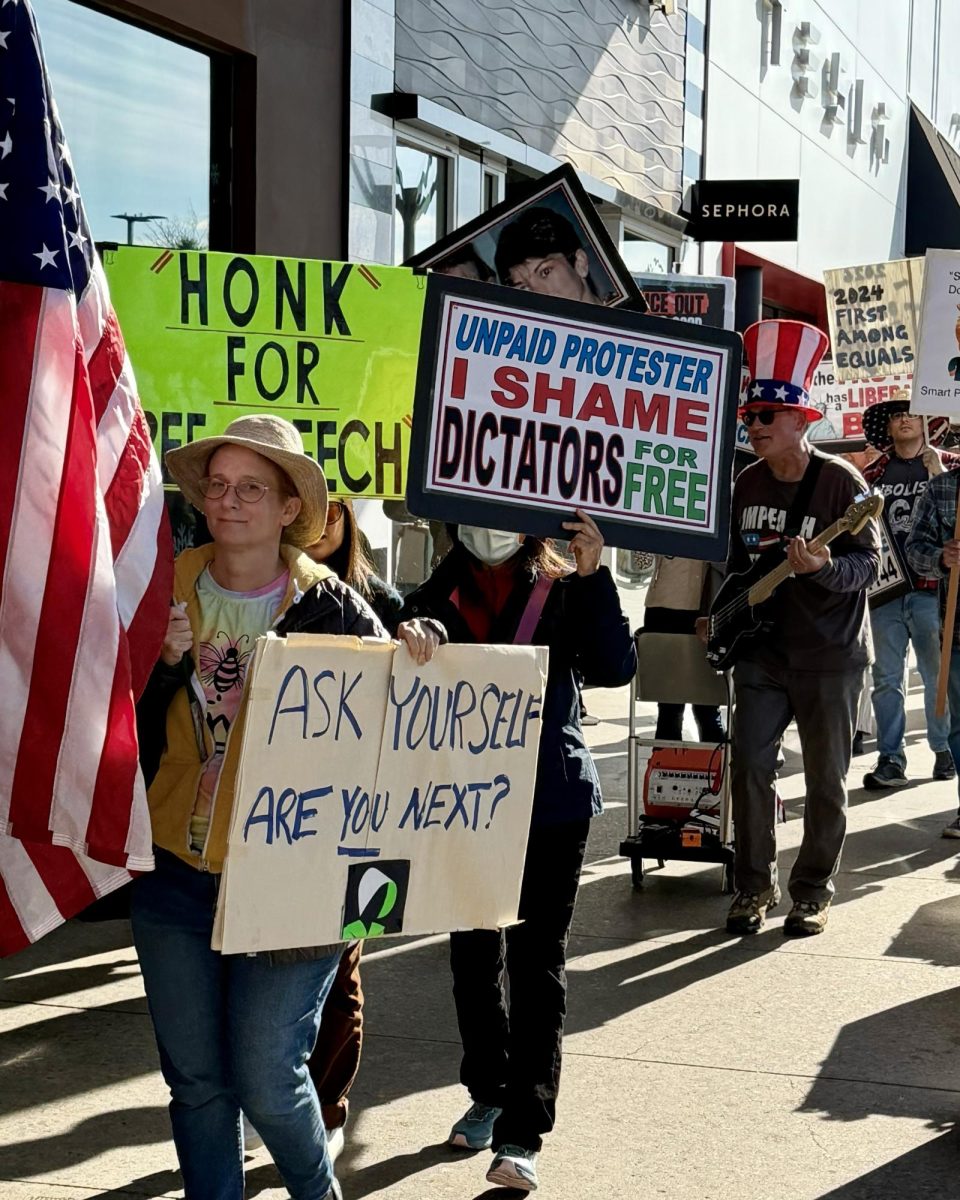
A year ago, on a Saturday afternoon outside the Stanford Shopping Center, two protesters, one dressed as Waldo and the other as Jesus Christ, stood outside a Tesla dealership, shouting and holding up signs as they tried to catch the attention of passing shoppers, according to Scott Herscher, the founder of The Wolves. It was the first event he ever organized.
“Two people showed up,” Herscher said. “And I thought, maybe I am not so weird.”
Today, Herscher’s activist organization holds demonstrations three times a week across the Bay Area: Mondays at Whole Foods in Palo Alto, Tuesdays at the Redwood City courthouse, and Saturdays at Stanford Shopping Center.
What started as a two-person turnout has grown into a tight-knit community of hundreds of activists united around economic justice, immigration rights, and what Herscher describes as the collapse of democratic accountability.
Herscher studied at UC San Diego before becoming a software engineer at Apple, a career path that looks nothing like that of a protest organizer.
However, after Trump’s second inauguration, he felt politically hopeless. Because of this, he briefly joined Indivisible, a national organization founded during Trump’s first term by former Democratic staffers, but said the fit wasn’t right.
“I said, f— it, I’ll just start my own thing,” Herscher said. “I didn’t have any aspirations for anything. I’m just a weird dude, so I figured it’ll probably just be me and a couple other people.”
Unlike chapters of national organizations, the group doesn’t need to maintain outside compliance before acting, and Herscher says that’s exactly the point.
“If we have an idea for something we want to do, we can make it happen the next day,” Herscher said. “You don’t have to get approval from anybody except ourselves, which I love.”
He has no plans to expand beyond the Bay Area. Scaling up nationwide would only recreate the restrictions he was trying to escape in the first place.
“I have no aspirations to take this nationally or bigger,” Herscher said. “I really like being hyperlocal. I have found that with national organizations that have local chapters, the local chapters are all constrained. And I just want to go do stuff.”

At the core of nearly everything, the Wolves’ protest centers on a single overarching concern: wealth inequality. Herscher describes the United States as the wealthiest country in history, yet also one of the most unequal.
“We’re living in a time of unprecedented wealth inequality,” Herscher said. “We’re also living in a time in which we’re one of the wealthiest countries in the history of the world. How do you square those two things? How do you square that there are a few people who have a f— ton of money, and then the rest of us are scrambling around to get the sloppy seconds?”
In his view, extreme wealth doesn’t just distort the economy; it distorts democracy itself. Billionaires, he argues, can exert political pressure that ordinary citizens simply cannot.
“Billionaires shouldn’t exist,” Herscher said. “If you’ve got a system where one small set of people can amass that much wealth at the expense of everybody else, you have an inherently unequal system, which is also inherently anti-democratic.”
One example of that fight is a ballot initiative that The Wolves have been actively supporting. According to CBS News, this measure, known as the “billionaire tax,” would impose a one-time 5% wealth tax on the state’s approximately 225 billionaires. This bill is intended to offset Medi-Cal cuts triggered by this year’s federal budget reconciliation bill. According to Herscher, the group has been focused on collecting signatures to get it on the November ballot.
“A guy who’s got $100 billion will be left with $95 billion,” Herscher said. “I’m not crying any tears.”
Polling, Herscher says, shows most Californians support the measure. He sees it as a sign that public sentiment is shifting.
“People are starting to wake up,” Herscher said. “They’re realizing maybe billionaires are not the solution, they’re the problem.”
But pushing that kind of change through the political system is easier said than done. Herscher described weeks of attempts to meet with staff at Rep. Sam Liccardo’s Campbell office, only to be turned away at the door each time.
“He works for us,” Herscher said. “We pay his f—— salary, and they wouldn’t open the door. But if we were Mark Zuckerberg, they would let us in. Mark Zuckerberg and I — we are both one vote, one person, yet because his bank account is a lot larger than my bank account, my representative won’t talk to me. That’s inherently anti-Democratic.”
His frustration may be more than just a personal experience. A 2015 study published in the American Journal of Political Science found that the members of Congress were more than five times as likely to meet with individuals when those people were identified as campaign donors.
One area where Herscher says the group has struggled is attracting high school protestors. He noted that a student organized a walkout in Los Altos that drew 200-300 participants, but that the energy rarely carries over into cross-generation participation.
“It doesn’t feel like the twain [two groups] shall meet,” Herscher said. “You were doing your thing, we were doing our thing, but there’s no congealing happening there. I would love to see events where we’ve got you guys [students] speaking and us listening and vice versa, but that’s not happening, which is kind of a bummer.”
Molly Schumer, a scientist and mother who regularly attends the group’s demonstrations, says the stakes for younger generations are exactly what compels her to keep showing up.
“I am worried about the future for my kids and worried about the future for democracy and science in America,” Schumer said. “It feels like a moral obligation when so much is going wrong.”
For young people following these protests, she had a direct message.
“We are at a critical moment in our democracy,” Schumer said. “I’m lucky that I grew up in a time when our rights were much less constricted than they are now. For young people, it’s the future that you are choosing.”
Still, Herscher remains committed to nonviolent protest as the primary strategy, and points to decades of political science research to back it up. One study from the Harvard Kennedy School of Government found that nonviolent campaigns were more effective at producing change and identified a threshold that Herscher himself often cites.
“There’s this magic number of 3.5%,” Herscher said. “If 3.5% of the population is activated and engaged in civil resistance, historically, we win. We don’t have that many levers; it’s one lever. That’s the one we’re gonna pull.”
He is also clear about why peaceful protest works beyond just the numbers.
“When people see this on TV and people see people peacefully protesting, not engaging in violent behavior, and then getting shot and beaten, it turns people who might not have been with them, with them,” Herscher said. “That’s why Martin Luther King was very intelligent and made a point of being non-violent. Then, it showed up on TV news that night, seeing non-violent people of color getting the s— kicked out of them by white cops, and it turned the electorate’s sentiments around.”
For now, Herscher says he will continue to show up, always with signs and support, outside the Tesla dealership in Palo Alto, every Saturday afternoon, with a big smile on his face.
“We have fun,” Herscher said. “If you’re not having fun, you’re not doing it right.”