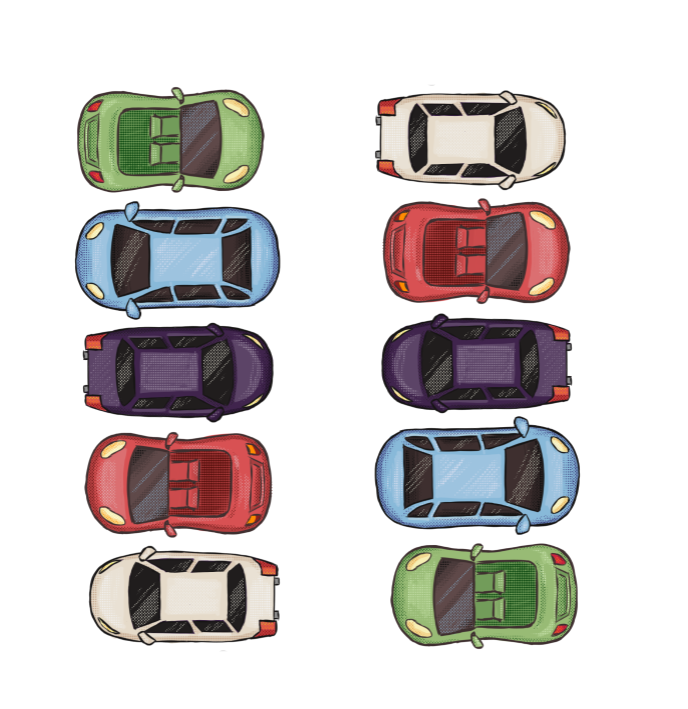
Cars idle between rows, inching forward as students search for spots in Palo Alto High School’s overcrowded parking lot. Drivers loop the area again and again, hoping someone will leave. Others give up and park in the nearby neighborhoods or Town and Country across the street — risking a ticket. Despite paying $100 for a single parking permit, many arrive late to class with nowhere to go.
This issue has worsened over time. As more and more students get their driver’s licenses throughout the year, demand increases while available parking has decreased.
According to Paly assistant principal Jerry Berkson, the lack of parking spots worsened this year.
“It [parking problem] has never been this noticeable,” Berkson said. “My guess is that with the enforcement happening less often, the students are willing to roll the dice and take a chance on getting a ticket.”
He attributes part of the problem to inconsistent enforcement. The Palo Alto Police Department, responsible for ticketing, has not been able to regularly monitor the lot, leading more students to park without permits.
Berkson said the school has not oversold permits, but illegal parking disrupts the system.
“The issue is the police department has not been able to come here [Paly] enough,” Berkson said. “We actually should have plenty of spots based on how many permits we’ve sold — we sold a lot less this year than last year. But if there’s no enforcement, students park illegally and take up spots that kids with permits can’t use. Even if they’re parking illegally, there isn’t anyone to enforce it anyway.”
Paly senior Charlotte Barclay said she’s experienced multiple disruptions in class by being asked to re-park her car for being parked illegally.
“When they [Paly administration] called me out, there was nowhere to go with my car,” Barclay said. “They continually called me out more and more times throughout the day until they finally said, ‘It is what it is.’ I felt like a pointless parking rule was valued more than my academics and my learning.”
Barclay’s experience reflects a larger issue with the current parking system, as even students who try to follow the rules are often left without fair or practical options. Students are forced to park in unofficial spaces, admin spots, or choose between risking a ticket or being late to class, while inconsistent enforcement undermines trust in the system.
As of now, Berkson said there are no major administrative changes planned to directly address the growing competition for parking. However, though administration has not prioritized upperclassmen when distributing parking permits this year, increasing parking issues may cause that policy to change next year.
“Parking permits are currently first come first serve, but next year, we probably will give priority to upperclassmen with this concern,” Berkson said.
Currently, students try to find other solutions by parking in nearby neighborhoods, which cap parking to two hours. The result means students end up losing valuable class time just to move their cars. Additionally, students get ticketed at Town and Country if enforcement notices their Paly Parking Permit, so they’re forced to remove it from their windshield, and many end up moving their cars to the Paly lots during lunch to avoid further suspicion.
Whether it’s better enforcement or clearer systems for handling violations, students deserve a parking system at Paly that is transparent and fair and allows students to actually park on campus. A system where paying for a permit actually means something and where following the rules doesn’t put you at a disadvantage. To restore fairness, the school should focus on consistent enforcement and clearer permit priorities, ensuring that students who follow the rules are not put at a disadvantage.
One simple solution the school should look into is taking steps to address the issue instead of leaving students to deal with the consequences on their own. One approach would be for Paly administrators or campus supervisors — rather than just PAPD officers — to conduct daily parking checks during the first period of the day by standing at parking lot entrances and asking to see the permit. To prevent traffic, Palo Alto Unified School District could fundraise for automatic machine checkers that would scan cars for their permits, similar to a toll system. Students without permits could face school-based consequences such as loss of future parking eligibility. As a result, if there are no spots for those with permits, they will just have to move their cars to a legal spot instead of facing additional warnings.
At the same time, the issue may require a larger conversation between students and administrators. Since parking affects numerous students daily, the school could form a committee through the Associated Student Body or the Principal’s Advisory Committee to gather student feedback and explore realistic solutions. This would allow students most affected by the issue to directly contribute ideas while helping administrators better understand how the current system impacts campus life.
While there is no easy fix, students who paid for permits should not feel punished for following the rules. But until then, the morning routine remains the same: circling the lot, watching the clock, and hoping that a spot opens up.