![SCOUTING FOR THE FUTURE - Social Justice Pathway co-founder Eric Bloom sits at his desk in room 805. Bloom said his experience both in Boy Scouts and as a teen leader gave him insight into how adults can facilitate teen leadership. “The part about Boy Scouts that makes it so successful … is that it’s so driven by the individual troop,” Bloom said. “It’s [all] up to you.”](https://anthromagazine.org/wp-content/uploads/2026/05/IMG_0661-675x1200.jpeg)
Dressed in a loose Hawaiian shirt and armed with a jovial wit, Eric Bloom — co-founder of the Social Justice Pathway — is known for his big personality and “can-do spirit” on campus. To his friends and colleagues, he’s a “rabble rouser,” the kind of person who always raises his hand during meetings. After 27 years at Palo Alto High School, Bloom is turning the page to a new chapter in his life by retiring at the end of this school year.
Bloom co-founded the SJP program in 2014, a separate pathway for students interested in social justice. Ever since SJPs founding, it has gained strong support from students, creating opportunities to build three-year-long bonds with one another.
Bloom said he wanted to create the SJP program to break free from the traditional classroom dynamic of a transactional way grades are given out based on points for assignments.
“We spend a lot of time thinking about the points and how to get the points and what to do with the points,” Bloom said. “The idea of a project-based program is that you’re going to sort of flip that around in the sense that we’ll spend some time talking about ‘How do we figure things out?’ ‘How do we know what’s there?’ and ‘What do we do to find out more information?’”
He feels that this project-based structure, paired with independent research, placed student agency at the forefront of all class activities.
“The research that they [SJP students] did [and] the history that they looked at as they created it [their projects] created these opportunities to find out more information,” Bloom said. “If I taught you how to dig with a shovel, that’s not really very much of a skill, but you can’t make a hole without knowing how to dig.”
Erin Angell, a fellow co-founder for the SJP program with Bloom, said she and Bloom were inspired to create a program that went beyond a simple transcript grade.
“We had this great opportunity that was presented by the district, [that said] ‘Well, why don’t you design a program that’s different’, and it was called the out-of-the-box program,” Angell said. “As teachers, a lot of times you are stuck with whatever the comprehensive high school structure can offer and can flex around. … [But] we did our research, and they [the school board] gave us the thumbs up, and we’ve been trucking ever since.”
Bloom’s program wasn’t without challenges; however, according to him, working with students in a way where all of them had a voice in the classroom. His teaching technique is based on assessing the students based purely on their ability to learn and grow in the class.
Instead of traditionally leading his students by the hand, Bloom was only there as a nudging force, urging students to arrive at conclusions themselves through the learning process.
“It’s just like, how are you going to demonstrate your competency and what do you want to do, so my job was to show them all of these different options and to see how other people are doing things, and then ask them to see what they can do,” Bloom said.
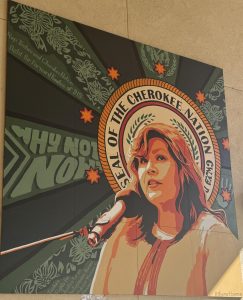
For him, the pinnacle of Bloom’s career is the creation of “Same Moon, Same Stars,” by SJP cohort 7, honoring the Cherokee Nation in 2023.
“[It was about] creating something authentic and [something that] exhibits learning and understanding and subtlety and conveyance and a little bit of protest,” Bloom said. “I think they [students] really felt proud of that accomplishment, and I’m not sure they would have made it as good as they did if they were only looking for an A.”
According to Caitlin Drewes, another SJP history teacher at Paly, Bloom’s signature teaching style is to let kids fail over and over until they grasp success through their own learning.
“Eric is such a master teacher,” Drewes said. “He really focuses on letting kids fail, and I don’t mean fail classes, but like, give it a shot. Try it. ‘Oh, it didn’t work. What can you do better? How can we fix that?’”
On top of being a master teacher in the eyes of fellow teachers, Bloom has also proved himself to be a voice for students and fellow staff on important matters in meetings that address social issues in the district.
“He’s definitely the rabble-rouser in the meetings,” Drewes said. “He does not let anybody get off the hook for a policy he doesn’t agree with, or an idea that isn’t fully explained.”
Cameron Toland, a former student of the class of 2023 whom Bloom taught for three years, said Bloom’s mentorship challenged her to share her perspective and communicate clearly.
“He would make me defend why I drove less than a mile to school every day rather than walking,” Toland stated. “I learned to better articulate my thoughts and opinions, and was always encouraged by [Bloom] to speak up for myself in and out of the classroom.”
In terms of Bloom’s eventual absence, Angell said his departure will leave a hole at Paly.
“Somebody is going to have to pick up the mantle,” Angell said. “I think it [the school] is going to be a little quieter, I think it’s going to be a little less quirky, and I think it’s going to be a little more polished.”