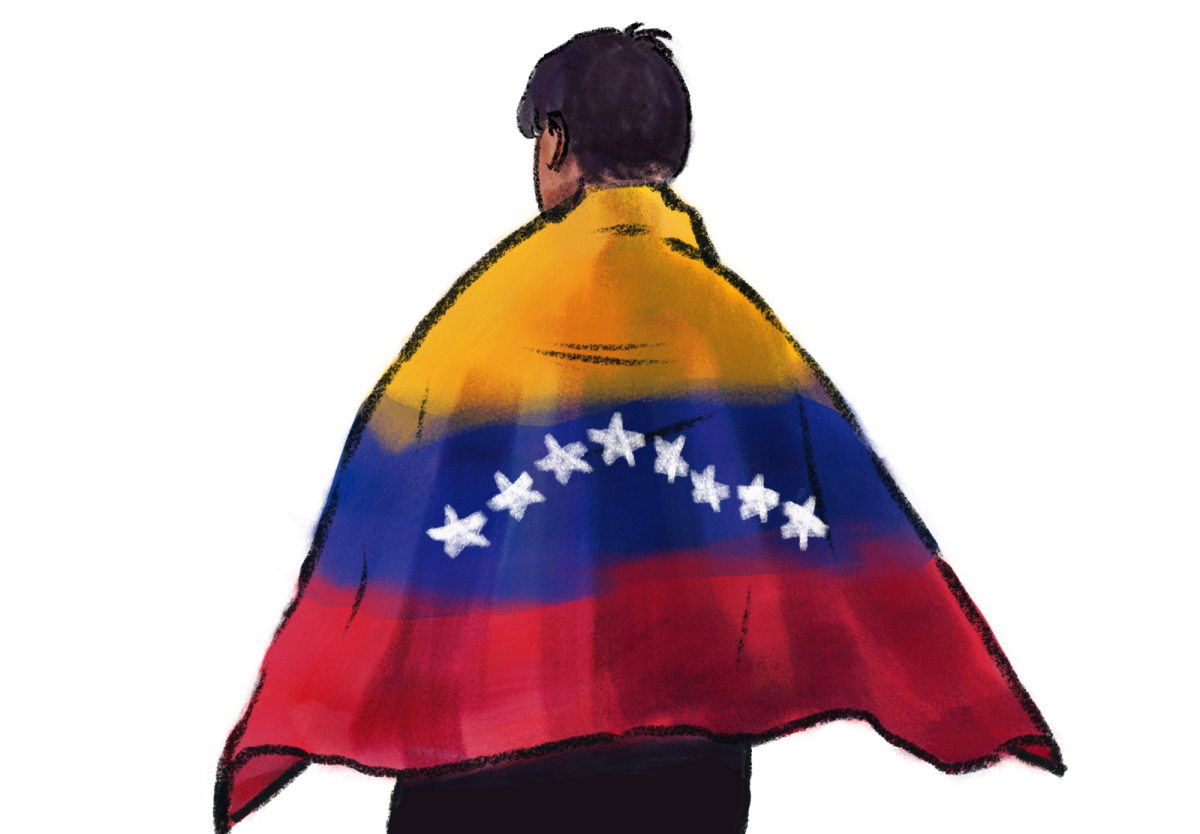
Ecstatic. That is the word Eliana Krulig, a Venezuelan immigrant mother living in the Bay Area, used to describe her reaction to the removal of Venezuelan President Nicholas Maduro in early January.
“My husband came to tell me, and I was in disbelief,” Krulig said. “And then when he told me, ‘I’m not joking’; I not only got excited, but I actually started crying, because it was such a big emotion for me, and for my family, or for everyone I know from Venezuela that this terrible, you know, horrible person, had finally been removed from our country.”
Krulig, who immigrated to the United States from Venezuela in 2005, was one of the lucky few who left early and had the means to do so.
“I want to say over the past seven to eight years, immigration was more like survival,” Krulig said. “You’re escaping, you’re walking out with a backpack and no money and no idea where you’re going. … You cannot survive in this country [Venezuela].”
Krulig is one of millions of Venezuelans living outside the country. According to the Pew Research Center, 1.2 million people are living in the U.S. who identify as Venezuelans, and whose story is wrapped up with the pain of the Maduro regime and the emotions around its fall.
Even after leaving the country, Krulig still feels love for her home country. She reminisces on the old memories and people that she had to leave behind.
“I talked to my family regularly,” Krulig said. “I still have friends from school, from college, and everyone… I think the sentiment is pretty universal.”
According to Krulig, even though the removal of Maduro is a sense of freedom for Venezuelans, she is still cautious about other potential leaders in the background who have supported his violent regime that could come to power afterwards.
“We’re cautiously optimistic that this is not the end of the dictatorship, because they have such a well-oiled machine that’s been in place, you know, for 25-26 years,” Krulig said. “So, yes, you remove Maduro, but he’s, I mean, he was the guy at the top, but he’s not, you know, the head of the snake. There are other people up there that are, that continue, you know, the government’s objectives and oppression.”
Luis, a local Venezuelan adult who requested to stay anonymous due to the Venezuelan government holding onto his personal information agrees with the approach the United States government is taking.
“[In the] first week of January, when Maduro was taken out of power, everyone thought that immediately Maria Corinna Machado would be put in place to run the country,” Luis said. “I actually don’t disagree with the approach that’s being taken right now, [by briefly leaving those] in power right now that are the same people that were there before.”
Machado, who won the election against Maduro in 2024, according to NPR, won the 2025 Nobel Prize in Norway for her efforts to promote democracy in Venezuela. Even after winning the election against Maduro, however, Machado was forced to flee the country because Maduro refused to leave office and decided to crack down massively against the opposition party.
Luis thinks that by putting the temporary leaders in charge, there is a bigger chance that by putting pressure on those leaders, change would really happen for the long term.
“So I think that it’s okay to provisionally leave those people in, [and to] put pressure on them to have them do what needs to be done,” Luis said.
Additionally, according to Luis, Venezuela’s government is framing the new regime change by the United States as an intentional act and not forced upon by America.
“If you hear the rhetoric that they have inside Venezuela, they make it seem like they’re doing everything on their own terms, individually and against the US government,” Luis said. “But if you look at what they’re doing, these are things that they would have never done if it wasn’t because they’re getting pressure from the US.”
Palo Alto High School teacher Adam Yonkers, who teaches Foreign Policy, expresses his own hesitancy towards the long-term success of the U.S. removal of Maduro, citing the U.S.’s heavy reliance on the local population revolting against the tyrannical government.
“But I think what you’re seeing is that by removing Maduro and leaving a lot of the people that were like his lieutenants, you’re hoping that there’s like a resistance movement that will come in that will be more pro-American,” Yonkers said.
Beyond that, Yonkers said he believes that recent events in Venezuela could pose a weakness for the U.S. globally, as China or Russia could use the same rationale America used in the removal.
“The Trump administration is saying that we are going to run Venezuela just because we don’t like the regime,” Yonkers said. “I think that moves us away from respect of nationhood and sovereignty, and it creates opportunities for China and Russia to, in some way, justify their actions.”
Luis supports putting pressure on current members of the Venezuelan government for improvements for the country, instead of putting in someone who has never had experience within the role.
“If you were to bring someone to a place where there’s so much chaos and that person doesn’t actually have the right people in the right positions … it’s gonna fail, everything’s gonna fail,” Luis said. “So I think that it’s okay to leave those people in, [and] put pressure on them to have them do what needs to be done.”
Luis’s response to Americans who tell him that the U.S. has no business interfering in Venezuelan affairs is that they do not understand the gravity of the emotion that is associated with Venezuelans for Maduro’s removal.
“[What] I would tell them is that, you know, you will have to be Venezuelan and live in Venezuela to understand how painful it is for those who are there and those who are outside, and therefore why we are all so excited,” Luis said.